pDG1663 枯草芽孢杆菌整合表达载体 BioVector® pDG1663 Bacillus subtilis Integration Expression Vector
- 价 格:¥49980
- 货 号:BioVector® pDG1663
- 产 地:北京
- BioVector NTCC典型培养物保藏中心
- 联系人:Dr.Xu, Biovector NTCC Inc.
电话:400-800-2947 工作微信:1843439339 (QQ同号)
邮件:Biovector@163.com
手机:18901268599
地址:北京
- 已注册
BioVector® pDG1663 枯草芽孢杆菌整合表达载体 BioVector® pDG1663 Bacillus subtilis Integration Expression Vector
第一部分:中文说明
一、 产品基本信息与详细特征描述
产品名称:BioVector® pDG1663 枯草芽孢杆菌整合表达载体
载体名称:BioVector® pDG1663
质粒类型:枯草芽孢杆菌整合型载体 (Bacillus subtilis Integration Vector)
抗性基因:大肠杆菌选择抗性为氨苄青霉素 (Ampicillin);枯草芽孢杆菌整合选择抗性为红霉素 (Erythromycin) 与林可霉素 (Lincomycin) 联合选择(即 MLS 抗性表型)
整合位点:amyE 位点(双交换同源重组)
生物安全级别:1级 (BSL-1)
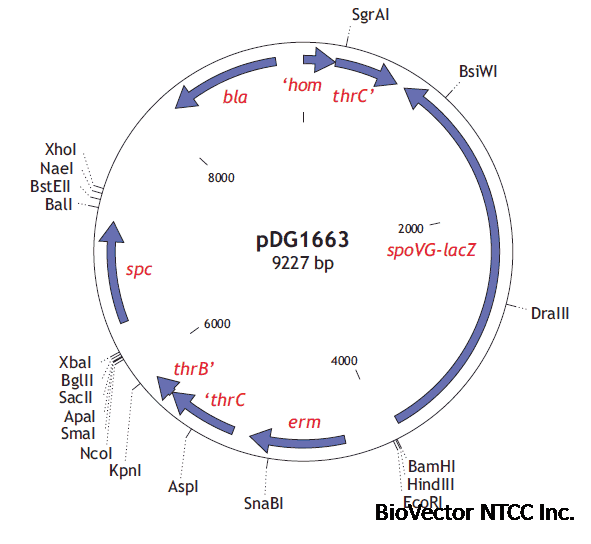
详细特征描述:BioVector® pDG1663 是一种专门用于枯草芽孢杆菌 (Bacillus subtilis) 基因组定点整合与异源基因高效表达的经典分子生物学载体。该载体设计核心包含大肠杆菌 (E. coli) 复制子,允许在通用大肠杆菌宿主中进行高效克隆、扩增与质粒提取。载体不具备在枯草芽孢杆菌中自主复制的能力,而是依赖于其两侧侧翼的 amyE 基因同源片段。当转入枯草芽孢杆菌后,载体通过双交换(Double-crossover)同源重组事件,将目的基因片段及伴随的 MLS 抗性标记精准插入到宿主染色体的 amyE(α-淀粉酶)位点中,导致宿主内源 amyE 基因失活。该整合策略能够实现目的基因在宿主基因组中的单拷贝单向稳定集成,彻底解决因质粒不稳定或由于自发丢失导致的表达量波动问题。其自带的强启动子区域可驱动下游异源蛋白的高效、持续表达,是原核表达、工业酶制剂改造、代谢途径构建及枯草芽孢杆菌基因功能研究的理想分子工具。
二、 细胞培养与质粒克隆条件
大肠杆菌克隆与扩增条件:为了进行载体克隆、片段插入或质粒大量提取,应将质粒转化至常规大肠杆菌感受态细胞(如 DH5a 或 Top10)。使用配置好的 BioVector® LB 液体培养基或 BioVector® LB 固体琼脂培养基,并在其中添加终浓度为 100 微克每毫升的 BioVector® 氨苄青霉素。在 37°C 恒温振荡培养箱中以每分钟 200 到 220 转的转速孵育过夜。
枯草芽孢杆菌转化与筛选条件:完成目的片段克隆的高质量质粒,通过化学转化或电转化方式导入枯草芽孢杆菌感受态细胞。转化后的细胞需要接种于添加了 MLS 选择性抗生素的 BioVector® 营养琼脂或 BioVector® 营养肉汤培养基中。标准筛选浓度通常为每毫升 1 微克的 BioVector® 红霉素结合每毫升 25 微克的 BioVector® 林可霉素。孵育环境参数设定为 37°C 恒温培养。
三、 枯草芽孢杆菌整合与传代操作步骤
质粒制备与线性化:使用 BioVector® 高纯度质粒提取试剂盒从大肠杆菌中提取足量的 BioVector® pDG1663 重组质粒。为了大幅度提高枯草芽孢杆菌中的双交换同源重组效率,建议在转化前使用限制性内切酶在非同源区域内对质粒进行线性化处理。
枯草感受态转化:将线性化或超螺旋状态的重组质粒加入到处于感受态生长末期的枯草芽孢杆菌悬液中,轻柔混匀,于 37°C 静态孵育 30 到 45 分钟以促进 DNA 分子的摄取。
转化后恢复:向转化混合物中加入适量预热的富集培养基(如 BioVector® Spizizen 最小培养基或预热重组恢复肉汤),置于 37°C 振荡培养箱中低速复苏 1 到 1.5 小时,使其抗性基因得到充分表达。
抗性平板筛选:将复苏后的菌液均匀涂布于含有特定浓度 BioVector® 红霉素与林可霉素联合抗性的筛选平板上,倒置放入 37°C 培养箱中孵育 18 到 24 小时,直至平板上长出清晰的单克隆。
整合表型验证 (amyE 阴性测试):由于双交换整合会导致枯草芽孢杆菌的 amyE 基因断裂,可通过淀粉水解实验进行快速表型鉴定。将长出的转化子挑取点样于含有 1% 可溶性淀粉的 BioVector® 营养琼脂平板上,37°C 培养过夜。随后向平板上倾倒适量 BioVector® 碘液。若菌落周围未出现透明的水解圈(即淀粉不被水解),则初步证实目的片段已成功整合于 amyE 位点。随后应提取基因组进行 PCR 构建验证。
四、 质粒冻存与长期保藏技术
大肠杆菌菌种冻存:克隆有正确质粒的大肠杆菌菌液,在对数生长旺盛期(OD600 达到 0.6 到 0.8 时),吸取 700 微里菌液与 300 微里无菌的 BioVector® 细胞级甘油(最终甘油浓度为 30%)在无菌冻存管中充分混匀。利用程序降温或直接置于零下 80°C 超低温冰箱中进行长期、稳定的保藏。
质粒 DNA 储存:纯化后的质粒 DNA 应当溶解于无菌的 BioVector® TE 缓冲液或无酸性超纯水中,测量浓度后将其分装。置于零下 20°C 冰箱中可稳定保存数年,避免反复冻融以防止质粒 DNA 链断裂。
五、 质量控制与科研应用指南
质量控制标准:BioVector® pDG1663 载体经过严格的纯度、浓度和序列完整性检测。通过酶切电泳分析验证其质粒图谱的准确性;通过高通量测序确认克隆位点及关键抗性基因序列无突变;确保无外源核酸、核酸酶(DNase/RNase)及细菌内毒素污染。
主要实验应用:该整合载体主要用于枯草芽孢杆菌异源蛋白表达系统的构建、工业生产用工程菌株的遗传改造、稳定多拷贝表达株系的前体构建、复杂代谢通路基因的染色体逐个敲入,以及芽孢杆菌内部调控元件与启动子强度的体内定量分析。
PART 2: ENGLISH SECTION
I. General Information and Detailed Product Characterization
Product Name: BioVector® pDG1663 Bacillus subtilis Integration Expression Vector
Vector Name: BioVector® pDG1663
Plasmid Type: Bacillus subtilis Integration Vector
Antibiotic Resistance: Ampicillin for selection in E. coli; Macrolide-Lincosamide-Streptogramin B (MLS) resistance (Erythromycin and Lincomycin combined) for chromosomal integration selection in B. subtilis.
Integration Site: amyE locus (via double-crossover homologous recombination)
Biosafety Level: BSL-1
Detailed Description: BioVector® pDG1663 is a classical molecular biology vector dedicated to site-specific chromosomal integration and highly stable heterologous gene expression in Bacillus subtilis. The design of this vector incorporates an E. coli replicon, allowing for efficient cloning, modification, and high-yield plasmid extraction within common laboratory E. coli host strains. Crucially, the plasmid lacks a functional replication origin for Bacillus subtilis, meaning its persistence in the host relies entirely on homologous recombination directed by the flank sequences of the amyE gene. Upon transformation into B. subtilis, a double-crossover event integrates the target gene cassette along with the MLS resistance marker precisely into the chromosomal amyE (alpha-amylase) locus, simultaneously rendering the endogenous amylase gene inactive. This integration strategy secures a single-copy, highly stable genotypic preservation within the host genome, eliminating expression fluctuations caused by plasmid instability or segregational loss. Driven by its embedded strong promoter region, it supports sustained and efficient synthesis of target proteins, serving as an outstanding molecular tool for prokaryotic expression, industrial enzyme optimization, metabolic engineering, and functional genomics.
II. Culture Conditions and Cloning Parameters
E. coli Maintenance and Amplification: For general cloning, insert ligation, or high-yield plasmid purification, the vector should be transformed into standard E. coli competent cells (e.g., DH5a or Top10). Cells must be cultivated using professionally prepared BioVector® LB Liquid Medium or BioVector® LB Agar Medium supplemented with BioVector® Ampicillin at a final concentration of 100 micrograms per milliliter. Incubate in a temperature-controlled shaking incubator at 37°C with an agitation speed of 200 to 220 RPM overnight.
B. subtilis Selection and Growth Conditions: Verified recombinant plasmids carrying the target fragment are introduced into B. subtilis competent cells via chemical transformation or electroporation. Successfully transformed colonies are strictly selected on BioVector® Nutrient Agar or BioVector® Nutrient Broth containing MLS antibiotics. The standard working concentrations are 1 microgram per milliliter of BioVector® Erythromycin combined with 25 micrograms per milliliter of BioVector® Lincomycin. The incubation environment must be constantly maintained at 37°C.
III. Standardized B. subtilis Integration and Subculturing Protocol
Plasmid Preparation and Linearization: Extract a sufficient quantity of the recombinant BioVector® pDG1663 plasmid using a BioVector® High-Purity Plasmid DNA Extraction Kit. To maximize the frequency of double-crossover homologous recombination in Bacillus subtilis, it is highly recommended to linearize the plasmid using a restriction enzyme that cuts within a non-homologous backbone region prior to transformation.
Competent Cell Transformation: Add the linearized or supercoiled recombinant plasmid directly into the B. subtilis competent cell suspension harvested at the late-competent growth stage. Mix very gently and incubate statically at 37°C for 30 to 45 minutes to facilitate DNA uptake by the cells.
Post-Transformation Recovery: Supplement the mixture with an appropriate volume of pre-warmed recovery broth, such as BioVector® Spizizen Minimal Medium or a rich outgrowth broth. Incubate in a shaking incubator at 37°C at a low agitation speed for 1 to 1.5 hours to allow adequate phenotypic expression of the antibiotic resistance genes.
Antibiotic Plate Selection: Spread the recovered culture evenly onto selective plates containing the designated concentrations of combined BioVector® Erythromycin and Lincomycin. Invert the plates and incubate them in a 37°C incubator for 18 to 24 hours until distinct single colonies appear.
Integration Verification (amyE Negative Test): Because successful double-crossover integration disrupts the native amyE gene, a starch hydrolysis assay provides rapid phenotypic identification. Patch selected transformants onto a BioVector® Nutrient Agar plate supplemented with 1% soluble starch and grow overnight at 37°C. Flood the plate surface with BioVector® Iodine Solution. The absence of a clear halo or zone of clearing around the colony (indicating starch remains unhydrolyzed) initially confirms target integration at the amyE locus. This must be further verified by genomic DNA extraction and PCR analysis.
IV. Plasmid Preservation and Long-Term Storage Methodology
E. coli Glycerol Stock Preservation: For long-term storage of host bacteria carrying the validated plasmid, collect E. coli cultures during their active logarithmic growth phase (OD600 between 0.6 and 0.8). Mix 700 microliters of the bacterial suspension thoroughly with 300 microliters of sterile BioVector® Cell-Grade Glycerol (achieving a final concentration of 30% glycerol) inside a sterile cryovial. Store the cryovial in a minus 80°C ultra-low temperature freezer.
Purified Plasmid DNA Storage: Purified plasmid DNA should be dissolved in sterile BioVector® TE Buffer or nuclease-free ultra-pure water. Measure the concentration, aliquot into small volumes, and store at minus 20°C. Aliquoting prevents repetitive freeze-thaw cycles that can induce double-stranded DNA breaks.
V. Quality Control and Research Application Guidelines
Quality Control Standards: The BioVector® pDG1663 vector undergoes stringent quality assessments regarding purity, concentration, and structural integrity. Structural alignment is confirmed via restriction enzyme digestion profiling; cloning sites and key resistance markers are fully verified via high-throughput sequencing to ensure no spontaneous mutations exist. The product is certified free from exogenous nucleic acids, host nucleases (DNase/RNase), and bacterial endotoxins.
Core Experimental Applications: This integration vector is widely used for constructing stable heterologous protein expression systems in B. subtilis, genetic engineering of industrial production strains, fabricating stable precursor strains for multi-copy expression, chromosomal knock-in of sequential genes within complex metabolic pathways, and in vivo quantitative characterization of native regulatory elements and promoter strengths.
BioVector NTCC质粒载体菌株细胞蛋白抗体基因保藏中心
电话:400-800-2947
工作QQ/微信同号:1843439339
网址
http://www.biovector.net
- 公告/新闻