p423-Gal 酵母表达质粒载体 BioVector® p423-Gal Yeast Expression Vector
- 价 格:¥49980
- 货 号:BioVector® p423-Gal
- 产 地:北京
- BioVector NTCC典型培养物保藏中心
- 联系人:Dr.Xu, Biovector NTCC Inc.
电话:400-800-2947 工作微信:1843439339 (QQ同号)
邮件:Biovector@163.com
手机:18901268599
地址:北京
- 已注册
BioVector® p423-Gal 酵母表达质粒载体
BioVector® p423-Gal Yeast Expression Vector
第一部分 中文说明
一 载体基本信息与科研用途
载体名称:BioVector® p423-Gal
载体类型:酿酒酵母(Saccharomyces cerevisiae)单拷贝/低拷贝穿梭表达质粒载体。
核心用途:专门用于在酿酒酵母中实现外源目的基因的半乳糖严格诱导型、高精准转录调控表达。
复制子与拷贝数:
大肠杆菌:含有 pUC 复制子,表现为高拷贝。
酿酒酵母:含有 CEN6/ARSH4 核心穿梭复制子元件。这是一种典型的着丝粒(Cen)型质粒,在酵母细胞分裂过程中能够像天然染色体一样精准地分配到子代细胞中,维持 1 到 2 个拷贝/细胞 的超低拷贝状态。其最大优势在于有丝分裂稳定性极高,且在不施加抗生素筛选压力下也不易发生质粒丢失。
抗性与选择标记:
大肠杆菌筛选:氨苄青霉素抗性(Ampicillin,AmpR)。
酿酒酵母筛选:带有标准的 组氨酸营养缺陷型选择标记( 基因)。
常用宿主菌:大肠杆菌 DH5a、Top10 以及各类组氨酸缺陷型酿酒酵母底盘株(如 BY4741、INVSc1、W303-1A、AH109)。
二 关键结构域与元件配置
GAL1 严格诱导型启动子(GAL1 Promoter):
调控机制:该启动子受酵母内源性半乳糖代谢网络的极其严格控制。在以葡萄糖(Glucose)为碳源的培养基中,由于碳源分解代谢物阻遏效应(Catabolite repression),GAL1 启动子的转录活性被彻底关闭(完全阻遏状态)。当将酵母细胞转移至以非阻遏碳源(如精制棉子糖 Raffinose)生长,并加入 D-半乳糖(D-Galactose) 作为诱导剂时,启动子被强效激活,驱动下游目的基因爆发式转录。
核心优势:适合用来表达对酵母具有高度毒性、严重阻碍细胞生长或诱导宿主凋亡的异源不稳定重组蛋白质(先在葡萄糖中扩增生物量,随后切换至半乳糖短期高强度诱导表达)。
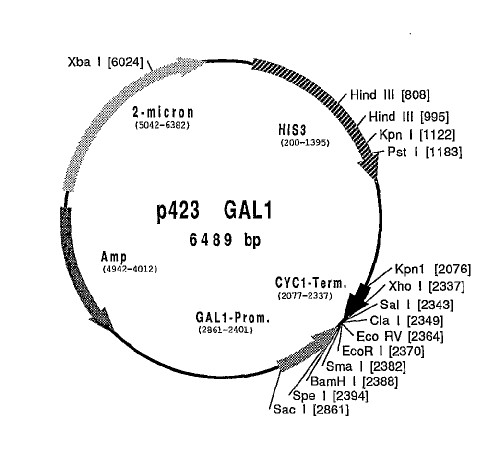
多克隆位点(MCS):位于 GAL1 启动子正下方,集成了多种独特的限制性内切酶位点(如 BamHI, EcoRI, SalI, XhoI 等),便于目的片段的高效定向克隆。
CYC1 终止子(CYC1 Terminator):下游搭载细胞色素c1终止子,保障外源 mRNA 3端加工、多聚腺苷酸化(Polyadenylation)的精准完成及转录的正常终止。
三 标准分子克隆与转化操作步骤
目的基因克隆:选用 MCS 中的合适酶切位点,将 PCR 扩增的目的基因片段定向连接入 BioVector® p423-Gal 载体,转化大肠杆菌并进行定点酶切质控与测序验证。
酵母感受态制备与转化:采用经典的醋酸锂(LiAc)/单链载体DNA(ssDNA)/聚乙二醇(PEG 3350)热激法,将提取的高纯度重组质粒导入组氨酸缺陷型酿酒酵母(如 BY4741)中。
阳性转化子筛选:将转化后的酵母细胞悬液涂布于 BioVector® 酵母合成完全组氨酸缺陷型固体选择培养基(SD/-His 培养基,以2%葡萄糖为碳源) 平板上,30摄氏度静置培养 2 到 4 天,挑取长出的单克隆。
半乳糖诱导表达验证:
种子液扩增:将阳性克隆接种于液体 SD/-His(含2%葡萄糖)中培养至对数生长中后期。
碳源适应(可选):离心收集细胞,用无菌水洗涤后,重悬于以 2% 棉子糖(Raffinose)为碳源的 -His 培养基中增殖 12 小时,以彻底消耗残存的葡萄糖。
爆发诱导:离心收集细胞,按 的起始密度重悬于含有 2% D-半乳糖(D-Galactose) 的 -His 诱导培养基中,30摄氏度继续振荡培养 12 到 24 小时,收集细胞生物量进行 SDS-PAGE、Western Blot 或功能活性测定。
四 核心科研应用方向
酵母毒性蛋白/致死性基因的功能病理学解析:由于 GAL1 启动子在葡萄糖中的“零背景”阻遏特性,该载体是研究各类植物/动物毒性蛋白(如朊病毒蛋白、细胞凋亡诱导因子 AIF、特定具有单向抑制作用的抗体片段)在酵母中胞内表达与遗传毒理的最理想控速系统。
低拷贝稳定多亚基复合物的重构:利用 CEN 质粒表现出的染色体级超高分离稳定性和低拷贝特征(杜绝了 2微米 质粒因拷贝数过高而导致的蛋白质非特异性聚集和错误折叠),与 p424-Gal(带有 TRP1 标记)、p425-Gal(带有 LEU2 标记)等系列载体并行使用,在同一酵母细胞中精准共表达多聚体酶复合物的各个亚基。
代谢途径关键限速酶的剂量敏感性分析:用于在合成生物学路线中,以单拷贝级别微调特定外源代谢通路中限速步骤酶的转录通量,从而精确定量分析不同碳源流量切换下的产物产率变异,避免由高拷贝质粒造成的代谢负担过重(Metabolic burden)。
PART 2 ENGLISH SECTION
I General Information and Applications
Vector Name: BioVector® p423-Gal
Vector Type: Saccharomyces cerevisiae Low-Copy/Single-Copy Centromeric Shuttle Expression Vector.
Primary Application: Engineered specifically for highly stringent, galactose-inducible, and low-fluctuation transcriptional control of heterologous target genes inside budding yeast.
Replicon Infrastructure & Copy Number:
Escherichia coli: Outfitted with a high-copy pUC replication origin for high-yield plasmid preps.
Saccharomyces cerevisiae: Carries the distinct CEN6/ARSH4 centromeric shuttle replication assembly. This design behaves analogously to an autonomous mini-chromosome during yeast mitosis, maintaining a uniform, non-fluctuating baseline of 1 to 2 copies per cell. It provides excellent mitotic retention stability even across prolonged generations without continuous auxotrophic selection pressures.
Selection Flags:
Bacterial Selection: Ampicillin resistance gene (AmpR) for propagation inside E. coli backbones.
Yeast Selection: Outfitted with the functional Histidine auxotrophic complementary marker (genuine gene).
Common Host Systems: E. coli DH5a, Top10, and any standard histidine-deficient Saccharomyces cerevisiae strains (e.g., BY4741, INVSc1, W303-1A, AH109).
II Vector Anatomy and Component Configuration
GAL1 Stringent Inducible Promoter:
Regulatory Circuit: Driven by the host cell's endogenous galactose utilization network. When cultured in media formulated with glucose, the promoter is completely silenced and shut down through carbon catabolite repression pathways. Upon moving the biomass to non-repressing carbon configurations (such as refined Raffinose) and introducing D-Galactose, the repression is undone, activating transcription of the downstream open reading frame.
Core Technical Value: Highly prioritized for the successful cloning and expression of heterologous proteins that are highly toxic, cytostatic, or prone to initiating rapid autogenous cell death in yeast. It permits unhindered biomass expansion in glucose before triggering targeted protein synthesis.
Multiple Cloning Site (MCS): Arranged directly underneath the GAL1 driving framework, incorporating unique restriction endpoints (such as BamHI, EcoRI, SalI, XhoI) for seamless, directional open reading frame integration.
CYC1 Terminator: Positioned downstream of the MCS, utilizing the yeast Iso-1-cytochrome c terminator profile to command accurate mRNA 3'-end trimming, polyadenylation processing, and consistent elongation termination.
III Subcloning and Yeast Transformation Protocols
Target Subcloning: Excise the target open reading frame and integrate it directionally into compatible restriction sites within the dense MCS of BioVector® p423-Gal. Propagate the construct inside competent E. coli, verifying structural correctness via diagnostic restriction cuts and sequencing.
Yeast Competent Delivery: Utilize the standard Lithium Acetate (LiAc) / Single-Stranded Carrier DNA (ssDNA) / Polyethylene Glycol (PEG 3350) heat-shock protocol to transform the pure recombinant plasmid into a histidine-deficient yeast chassis (e.g., BY4741).
Auxotrophic Selection: Plate the transformed slurry directly onto BioVector® Synthetic Dextrose Histidine-Dropout agar plates (SD/-His solid agar supplemented with 2% glucose). Incubate undisturbed at 30 degrees Celsius for 2 to 4 days until robust complementary colonies emerge.
Galactose Induction Protocol:
Pre-Culture Phase: Inoculate a confirmed single colony into liquid SD/-His (with 2% glucose) and grow until mid-to-late log phase.
Repression Cleansing (Optional Step): Pellet the cells, wash away residual carbohydrate tracks with sterile water, and re-incubate the biomass in -His media made with 2% Raffinose for 12 hours to completely exhaust baseline internal glucose stores.
Target Induction Challenge: Harvest the cells and resuspend them at an initial seeding baseline of in fresh synthetic induction broth containing 2% D-Galactose (as the sole carbon feed). Run the expression kinetics under continuous agitation at 30 degrees Celsius for 12 to 24 hours before processing the yeast pellet for SDS-PAGE, Western blot, or direct functional profiling.
IV Strategic Research Applications
Deciphering Functional Cascades of Yeast-Toxic and Lethal Targets: Thanks to the absolute zero-background repression profile of the GAL1 promoter under glucose, this vector serves as a premier research system to maintain, amplify, and then study volatile heterologous proteins (e.g., specific mammalian prions, apoptotic factors like AIF, or cytotoxic antibody formats) without suffering premature plasmid mutation or culture decay.
Reconstitution of Mitotically Stable Multi-Subunit Complexes: Utilizing its centromeric single-to-low copy distribution properties, it prevents the abnormal multi-protein aggregation or misfolding artifacts frequently caused by high-copy 2-micron vector formats. It is frequently multiplexed alongside complementary platforms like p424-Gal (TRP1 marker) or p425-Gal (LEU2 marker) to orchestrate balanced stoichiometric co-expression of multi-mer enzyme assemblies.
Dosage-Sensitivity Profiling in Synthetic Pathway Networks: Extensively deployed in synthetic biology pipelines to evaluate how strict low-copy transcriptional flux adjustments of rate-limiting pathway steps affect overall metabolic product yields. It helps optimize pathway balance while eliminating the severe metabolic burdens typically imposed by over-amplified high-copy vectors.
BioVector NTCC质粒载体菌株细胞蛋白抗体基因保藏中心
电话:400-800-2947
工作QQ/微信同号:1843439339
网址
- 公告/新闻