IPTI002-A 人诱导多能干细胞株 BioVector® IPTI002-A Human Induced Pluripotent Stem Cell Line
- 价 格:¥99860
- 货 号:BioVector® IPTI002-A
- 产 地:北京
- BioVector NTCC典型培养物保藏中心
- 联系人:Dr.Xu, Biovector NTCC Inc.
电话:400-800-2947 工作微信:1843439339 (QQ同号)
邮件:Biovector@163.com
手机:18901268599
地址:北京
- 已注册
BioVector® IPTI002-A 人诱导多能干细胞株
BioVector® IPTI002-A Human Induced Pluripotent Stem Cell Line
第一部分 中文说明
一 产品基本信息与遗传学背景
细胞名称:BioVector® IPTI002-A 人诱导多能干细胞
系统学 Accession:Cellosaurus CVCL_C5X8
物种来源:人类 (Homo sapiens)
性别来源:女性 (Female)
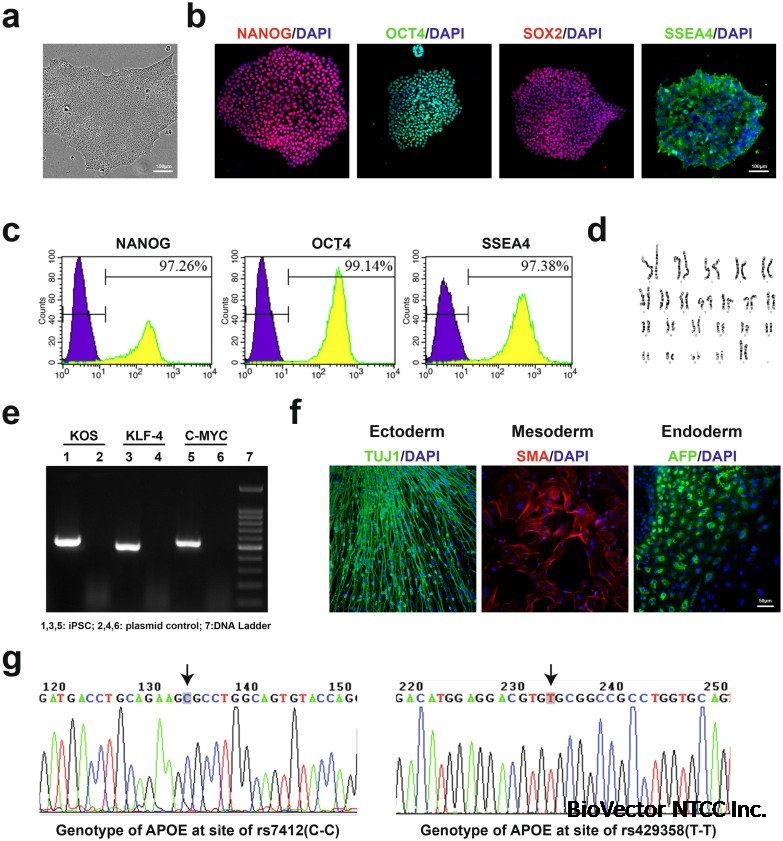
组织与重编程背景:该细胞株建立于一名健康女性捐献者的外周血单核细胞(PBMC)。通过使用非整合型的非对称仙台病毒(Sendai Virus)载体系统,导入标准的 Yamanaka 四因子(OCT4, SOX2, KLF4, c-MYC)进行重编程创制。由于重编程载体在随后的传代过程中被完全清除,该细胞株表现为无外源基因残留的非整合特性。
多能性分子特征:
核型特征:经严格鉴定表现为正常的女性二倍体核型(46, XX),在体外长期传代过程中能够保持极高的染色体核型稳定性。
多能性标志物:高水平表达干细胞核心转录因子 OCT4、NANOG、SOX2,且其细胞表面强阳性表达阶段特异性胚胎抗原 SSEA-4 以及肿瘤排斥抗原 TRA-1-60、TRA-1-81。
分化潜能:具备标准的三胚层(内胚层、中胚层、外胚层)全能分化潜能,在体内异种移植实验中可高效形成包含多组织成分的畸胎瘤(Teratoma)。
生物安全级别:1级(BSL-1)。
二 细胞形态学与特殊培养环境
形态学特征:在优质的基质胶(如 Matrigel)或人源重组玻璃体结合蛋白(Vitronectin)包被的基底上呈经典的贴壁克隆集落(Colony)状生长。集落边界清晰、极为紧密。单颗干细胞体积较小,核质比极高,且克隆内部细胞排列紧密。
生长模式:贴壁集落生长。
标准完全培养基配方:
基础与维持体系:BioVector® 无血清、无饲养层多能干细胞完全培养基(如经典稳定的 mTeSR Plus 或 Essential 8 增强型无血清制剂)。
基质包被:培养前基质表面必须经过 BioVector® 1比100稀释的基质胶(Matrigel)或高纯度 Vitronectin 溶液在 37摄氏度下包被 1 小时。
物理培养参数:37摄氏度恒温、5% 二氧化碳、空气饱和湿度(或选用 5% 氧气、5% 二氧化碳的三气低氧生理环境培养以维持其最高干性状态)。
三 细胞传代与复苏标准操作步骤
常规传代操作(建议采用温和的常规团块传代法法):
当多能干细胞克隆集落覆盖培养皿面积达到 75% 到 85%,且部分集落中心开始出现过密堆积时需要进行传代。切勿让克隆过度生长或相互融合,否则会导致细胞发生自发性分化。
吸除旧培养基,用无菌的无钙镁离子 1x PBS 洗涤 1 次。
加入适量温和的 BioVector® 0.5 mM EDTA 传代分离液(如 ReLeSR 或常规无酶分散液),在 37摄氏度下孵育 2 到 4 分钟。
显微镜下观察到集落边缘开始轻微回缩、变亮后,立即吸除分离液。加入新鲜完全培养基,用移液枪极其轻柔地吹吸 1 2 次,将克隆片层剥离并碎裂成大小适中的细胞团块(Clumps)。切勿将其消化吹打成单细胞,否则会引起大规模细胞凋亡。
推荐常规传代比例为 1比4 至 1比8,每 4 到 6 天传代一次。
特殊单细胞传代/接种策略(若实验需要单细胞铺板):
若需要进行高通量筛选或转染而必须打散成单细胞时,须使用 BioVector® Accutase 酶消化液,且在接种后的前 24 小时内,完全培养基中必须添加最终浓度为 10 μM 的 Rock 抑制剂(Y-27632),以特异性阻断单细胞悬浮引发的失巢凋亡(Anoikis)。
冻存细胞复苏:
从液氮中取出冷冻管,立即投入 37摄氏度 BioVector® 水浴锅中高频摇动使其快速融化,控制在 1到2 分钟内。
将解冻的细胞悬液移至含 5 mL 预热干细胞完全培养基的管中,常规速度低速离心 4 分钟(约 100 g)以沉淀团块。
弃去含有 DMSO 的上清,加入含有 10 μM Y-27632 的新鲜干细胞完全培养基重悬细胞团,接种于提前包被好基质胶的培养皿中。次日务必更换为不含 Y-27632 的常规完全培养基。
四 核心科研应用方向
人体器官类器官(Organoids)分化与发育生物学模型:BioVector® IPTI002-A 作为源自健康女性个体的无外源残留经典诱导多能干细胞系,广泛用作体外定向分化的高质量起始材料。通过多步法小分子组合诱导,可高效定向分化为脑类器官(Brain organoids)、心肌类器官(Cardiac organoids)及高纯度的定形内胚层细胞,用于解析人类胚胎早期器官发育的基因调控网络。
新型小分子/抗体药物体外发育毒性与致畸性评价:在制药工业的临床前安全评价中,该细胞常被用于搭建体外人胚胎干细胞试验(EST)替代模型。通过监测该株在药物干预下三胚层自发分化标志物(如内胚层 AFP、中胚层 Brachyury、外胚层 Nestin)的转录变异,评估待测候选化合物的生殖和发育毒性风险。
基于患者特异性的疾病模拟与基因编辑平台:利用 CRISPR/Cas9 基因编辑技术在该细胞株中引入特定的致病突变,或利用其作为正常对照组(Control line)与特定遗传病患者来源的 iPSCs 进行并行研究,用于揭示神经退行性疾病、代谢性心肌病等复杂疾病的分子病理,开展高通量的先导化合物药效筛选。
PART 2 ENGLISH SECTION
I General Information and Genetic Background
Cell Line Name: BioVector® IPTI002-A
Synonyms: IPTI002-A, IPTIi002-A
Cellosaurus Accession: CVCL_C5X8
Species Origin: Human (Homo sapiens)
Sex of Donor: Female
Tissue and Reprogramming History: Established from peripheral blood mononuclear cells (PBMCs) isolated from a healthy female donor. Reprogramming was executed utilizing a non-integrating, replication-incompetent Sendai Virus delivery system driving the standard Yamanaka pluripotency repertoire (OCT4, SOX2, KLF4, and c-MYC). The viral vectors are completely cleared out during downstream passaging, ensuring a transgene-free and footprint-free pluripotent genomic status.
Pluripotency and Karyotypic Traits:
Karyotype: Validated to harbor a stable, normal female diploid chromosome configuration (46, XX), demonstrating excellent genomic architecture retention across prolonged in vitro expansion cycles.
Core Markers: Robustly expresses essential stemness transcription factor networks including OCT4, NANOG, and SOX2, while displaying heavy apical presentation of stage-specific embryonic antigen SSEA-4 and tumor rejection antigens TRA-1-60 and TRA-1-81.
Lineage Competence: Possesses standard tri-lineage differentiation potential. Spontaneously differentiates into recognizable functional cell configurations representing the ectoderm, mesoderm, and endoderm layers, and reliably organizes multi-tissue teratomas during in vivo immunodeficient mouse transplantation validations.
Biosafety Level: BSL-1.
II Morphological Attributes and Cultivation Media
Morphology: Proliferates as classic adherent pluripotent colonies when cultured on validated ECM substrates such as Matrigel or recombinant human Vitronectin. Colonies display highly defined, sharp boundaries and compact cellular clustering. Individual cells within the colony maintain small diameters, high nuclear-to-cytoplasmic volume ratios, and dense intercellular contact arrangements.
Growth Mode: Adherent colony growth.
Standard Complete Growth Medium Formulation:
Basal Maintenance Matrix: BioVector® serum-free, feeder-free pluripotent stem cell complete medium (e.g., standard high-performance mTeSR Plus formulations or Essential 8 enhanced media parameters).
Surface Coating: Culture vessels must be pre-coated with BioVector® Matrigel (typically diluted 1:100 in cold basal medium) or purified recombinant Vitronectin solution, incubated at 37 degrees Celsius for 1 hour prior to cell deployment.
Physical Incubation Thresholds: Regulated strictly at 37 degrees Celsius under an atmospheric layer of 5% Carbon Dioxide and saturated air humidity (or adjusted to a tri-gas physiological hypoxic environment of 5% $O_2$ and 5% $CO_2$ to shield core stemness states).
III Subculturing and Thawing Protocols
Routine Passaging Schedule (Clump Passaging Method):
Initiate subculturing when the pluripotent colony aggregates cover 75% to 85% of the total vessel surface or when colony centers exhibit dense multi-layer packing. Avoid letting colonies overgrow or fuse completely, which triggers unwanted spontaneous differentiation lines.
Aspirate spent media and rinse the matrix once with sterile, calcium/magnesium-free 1x PBS.
Administer an appropriate volume of BioVector® 0.5 mM EDTA-based gentle dissociation reagent (such as ReLeSR or standard enzyme-free separation buffers) and incubate at 37 degrees Celsius for 2 to 4 minutes.
Once the colony edges show light contraction under light microscopy, instantly draw off the dissociation reagent. Dispense fresh complete maintenance medium and use a pipette to very gently wash and detach the colony sheets 1 to 2 times, breaking them down into small cell clumps. Do not forcefully dissociate the biomass into absolute single cells, as doing so initiates massive apoptosis.
Seed fresh matrix-coated vessels at a recommended split ratio of 1比4 to 1比8 every 4 to 6 days.
Single-Cell Dissociation Strategy (For Specific Experimental Setup):
If single-cell seeding is mandatory for parallel transfections or high-throughput sorting, dissociate the colonies using BioVector® Accutase reagent. Crucially, the fresh complete medium deployed during the preliminary 24-hour post-seeding window must be enriched with a final concentration of 10 μM Rock Inhibitor (Y-27632) to block single-cell anoikis circuits.
Cryovial Thawing and Recovery:
Retrieve the cryovial from storage and submerge it into a 37 degrees Celsius BioVector® water bath with rapid agitation until completely liquefied within 1 to 2 minutes.
Dilute the slurry immediately into a tube holding 5 mL of pre-warmed stem cell complete medium and spin down at a gentle velocity (around 100 g) for 4 minutes to pellet the clump structures.
Decant the DMSO-tainted supernatant, resuspend the remaining cell mass in fresh complete BioVector® medium supplemented with 10 μM Y-27632, and plate onto pre-coated matrix dishes. Perform a total medium refresh the following day to eliminate the Rock inhibitor.
IV Strategic Research Applications
Human Organoid Morphogenesis and Lineage Trajectory Mapping: BioVector® IPTI002-A serves as an excellent footprint-free normal reference line for directed lineage differentiation workflows. Guided by specific small-molecule temporal cocktails, it yields high-purity definitive endoderm, functional cardiomyocytes, or three-dimensional brain organoids, enabling the tracing of transcriptional networks governing early human organogenesis.
In Vitro Developmental Toxicity and Teratogenicity Bioprofiling: Deployed in preclinical drug safety screening pipelines to construct Embryonic Stem Cell Test (EST) alternatives. By tracking how test candidates impact or skew the tri-lineage spontaneous embryoid body differentiation profile (measuring endodermal AFP, mesodermal Brachyury, and ectodermal Nestin markers), toxicology networks can map embryotoxic risks of candidate small molecules or monoclonal formats.
Patient-Specific Isogenic Disease Modeling & Genome Engineering Platforms: Serves as a genetically clean wild-type baseline framework for introducing specific familial or sporadic pathogenic single-nucleotide polymorphisms via CRISPR/Cas9 tool suites. It acts as an excellent, non-mutated control line paired against patient-derived iPSCs to unravel molecular pathologies in neurodegenerative conditions or metabolic cardiomyopathies, driving accelerated high-throughput discovery loops for targeted leads.
BioVector NTCC质粒载体菌株细胞蛋白抗体基因保藏中心
电话:400-800-2947
工作QQ/微信同号:1843439339
网址
- 公告/新闻